You are seeing an unstyled version of this site. If this is because you are using an older web browser, we recommend that you upgrade to a modern, standards-compliant browser such as FireFox [http://www.getfirefox.com/], which is available free of charge for Windows, Mac and Linux.
Archival Texts of the Middle Assyrian Period
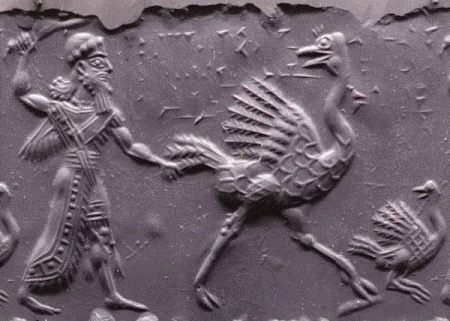
Middle Assyrian cylinder seal. Image by Daderot@wikimedia, listed as open domain
Versioned dataset: ATMAP/TCMA v1.0, Zenodo, https://doi.org/10.5281/zenodo.22978178
The Middle Assyrian empire (ca. 1500–1000 BCE) saw the expansion of the small state centred on the city of Assur (modern Qal'at Sherqat) towards the west. During the reign of Shalmaneser I (1273–1244/1263–1234 BCE), the rival state of Hanigalbat was defeated and new Assyrian colonies were founded at former settlements in the Habur region. Local administration at these sites produced texts that, together with those from the city of Aššur, constitute a corpus of over 3,000 cuneiform tablets. The Middle Assyrian period formally ends with the long reign of Tiglath-Pileser II (967–935 BCE), after which the Neo-Assyrian period began with a revival of Assyrian power under the leadership of Aššur-dān II (934–912 BCE). However, only a few texts can be dated to the period from the second half of the reign of Tiglath-Pileser I (1074–1056 BCE) onwards. The project Archival Texts of the Middle Assyrian Period, formerly Text Corpus of Middle Assyrian (TCMA), seeks to provide online transliterations, translations, and bibliographical references for Middle Assyrian administrative documents. The goal is to eventually provide editions of all administrative documents and Assyrian scholarly compositions.
ATMAP is being developed in cooperation with the Munich initiative Archival Texts of the Middle East in Antiquity (ATMEA), which is a branch of the Munich Open-access Cuneiform Corpus Initiative (MOCCI). The project was founded in early 2020 and is developed by PD Dr. Jacob Jan de Ridder.
To use ATMAP effectively, select "Browse the corpus" to find all available texts in one place, ordered by their main text publication. You can also easily find tablets using their Oracc P number or museum number. Texts are listed under their first main text publication. Therefore, VAT 8956 is found as KAJ 316, even though it was republished with an improved copy as MARV 1 22. If a text was published only in an article, its museum number is used. The large inventory published by Köcher in AfO 18 is included here as VAT 16462. An exception is made for the texts relisted in KAM 7: for example, the letter A 02429 is included as KAM 7, 145. Tablets in private collections are listed under the authors of their editions, e.g., Wilhelm 1997: AOAT 247. This letter is found in the folder "Private collection", together with Faist 2001: AOAT 265. For convenience, large groups of texts published in journals are still listed under the relevant journal volume. Thus, the Tell Rimah texts are found under Iraq 30, listed by their TR siglum. In addition, texts from Tell Billa (JCS 7) and Tell Ali (Iraq 70) use sigla based on their findspots (Billa and Ali). To find texts from a specific place, go to "Findspots", where they are listed in their respective subprojects. The general glossary and proper noun indices can be accessed below in the "Glossaries" menu; however, each subproject has its own set. Click the plus symbol to the left of each subproject to find them. This makes it easy to compare the vocabulary and onomasticon of the different sites. All proper nouns and nouns are standardized to (idealized) Standard Babylonian. This means that Urad-Šerūa is found in the onomasticon under W as Warad-Šerūa. Clicking on this name will display a list of attestations with different spellings and their Middle Assyrian realization (Urad-Šerūa) automatically rendered. Note that, following general Oracc conventions, statives are listed as adjectives. However, statives that take a direct object are given a secondary verbal meaning. A good example is našû "lifted", which can be found with the secondary meaning "bring (V)". Adjectives of secondary stems are listed separately (but finite verbs, unfortunately, are not), e.g., šūšubu "settled".
 [https://www.gkr.uni-leipzig.de/altorientalisches-institut]
 [https://www.en.ag.geschichte.uni-muenchen.de/research/mocci/index.html]