You are seeing an unstyled version of this site. If this is because you are using an older web browser, we recommend that you upgrade to a modern, standards-compliant browser such as FireFox [http://www.getfirefox.com/], which is available free of charge for Windows, Mac and Linux.
Inscriptions of Ashurnasirpal II

Ashurnasirpal II (883-859 BC) took up the kingship of an up-and-coming Assyria in 884. His predecessors had already initiated a process of reacquisition of territories lost especially to Aramean tribes during the twelfth-tenth centuries in what the Assyrians called the Land of Aššur, the region between the Zagros Mountains in the east and the Euphrates River in the west. Ashurnasirpal II and his son, Shalmaneser III [http://oracc.ub.uni-muenchen.de/riao/ria5/ShalmaneserIII/index.html], continued this process by further establishing political and administrative control over the Land of Aššur, and then extending Assyrian dominance beyond it. Both kings also distinguished themselves as builders of palaces, temples, and cities.
Ashurnasirpal's annals (text no. 1) indicate that, upon gaining the throne of Assyria, he immediately began a series of campaigns, initially to the regions of Ḫubuškia and Zamua in the Zagros Mountains to the east and to the Nairi lands in the northwest. Increasingly, however, he focused his attention on Suḫu to the south and, further west along the Euphrates, on the Aramean polity of Bit-Adini and Carchemish. Having reconquered this region, Ashurnasirpal II and his successors re-established widespread administration of it in a system of provinces, installing provincial governors at key cities. Ashurnasirpal then began to press his western expansion beyond the Euphrates. In his ninth regnal year, he marched as far as the Mediterranean, washed his weapons in the sea, and cut down cedars in the Amanus mountains with apparently little conflict. For Ashurnasirpal this was largely a matter of participating in a long-standing tradition of kings who marched to the western mountains, set up a monument there, and brought back some of their famous cedars. But this was the beginning of a great westward expansion: Ashurnasirpal's successors would march repeatedly to the region beyond the Euphrates, as well as to the north, east, and south, expanding Assyrian control, eventually, over much of the Near East.
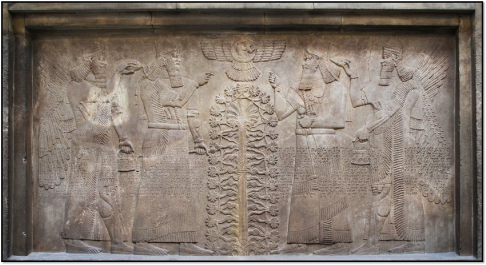
The Standard Inscription. See text no. 23
In addition to military success, Ashurnasirpal II was highly successful as a builder. His most impressive project was the transformation of the decrepit city of Kalḫu (mod. Nimrud) into a new capital. According to Ashurnasirpal's inscriptions, the city had been constructed by the Assyrian king Shalmaneser I [/riao/ria2/ShalmaneserI/index.html] (1263-1234 BC) but it had fallen into decay. In anticipation of moving the capital there from the old city of Ashur, the seat of kingship of Assyria for centuries, Ashurnasirpal constructed a new wall and a citadel platform and built several temples for his deities. His crowning achievement was a new royal palace, called the Northwest Palace today, which would be the principal Assyrian royal residence for a century-and-a-half. Its inner walls were famously paneled with colorfully painted stone orthostats, which were carved with relief scenes of protective spirits and apotropaic stylized trees. The king is also portrayed in narrative scenes, at war, on the hunt, or performing rituals. Each of the wall-panels was carved with its own copy of one of Ashurnasirpal II's royal inscriptions, which summarized his military conquests and described the construction of the Northwest Palace (text no. 23 ). This inscription was therefore copied as much as six hundred and fifty times in the palace, making it one of the most abundantly attested compositions from ancient Mesopotamia, so that it is appropriately named the "Standard Inscription." Major doorways of the palace were flanked by stone lamassātu, composite creatures with anthropomorphic heads and animal bodies which guarded the doorways. These, too, had inscriptions in the negative spaces between their legs and behind their tails (text no. 2 ). The massive proportions of the palace, complemented by its depictions in stone, incised in every direction with the king's inscriptions, communicated to visitors the sheer might of the Assyrian monarch and his special sanction by the divine realm. The completion of this palace is celebrated in a unique inscription on a stele which was installed in the throneroom courtyard of the Northwest Palace. We call this the Banquet Stele, because it tells of the banquet which was held in Kalḫu at the consecration of the palace, for which the king supplied tens of thousands of animals and massive amounts of other foods for a total of 69,574 guests, including people from all over the lands that Ashurnasirpal II had conquered, and delegations of dignitaries from lands outside the fringes of the Land of Aššur.
Browse the RIA 4 Corpus [/riao/ria4/pager/]
Bibliography
J. Caleb Howard
J. Caleb Howard, 'Inscriptions of Ashurnasirpal II', RIA 4: Inscriptions of Ashurnasirpal II, The RIA Project, 2024 [http://oracc.org/riao/ria4scores/]